The opening of the Connie Dixon Gallery
The light house: A love storyThe opening of the Connie Dixon Gallery is the decisive public culmination of Connie Dixon’s escape from Duncan Cartwright’s control and her effort to build an independent life in Hoyt Harbor. What begins as a dream formed during debt, artistic frustration, and emotional captivity becomes a functioning gallery filled with international collectors. At the same time, the opening converts Blake McGrath’s secluded paintings from private objects into public works and awakens his suppressed desire to create again.
From Escape to Institution
Connie arrives in Hoyt Harbor seeking answers and trying to preserve the last fragments of her freedom after Duncan Cartwright has taken control of her career, finances, and personal life. Her earlier artistic ambition had been replaced by gallery labor, debt, and coercion; she had once imagined exhibitions and recognition, but Duncan’s promises had become a means of possessing her. Against that history, her wish for a gallery is not merely a business plan. It is a claim to determine what art will be shown, how it will be valued, and what kind of life her work will support.
The possibility becomes concrete after Connie and Blake McGrath begin imagining a future beyond the isolation of the seaside house. Connie had described Hoyt Harbor as a piece of paradise, while Blake had answered that the place felt like a prison because of the grief attached to it. Their disagreement gives the gallery a double function: it becomes Connie’s entrance into a new community and Blake’s first movement away from a landscape dominated by loss. After Connie finds a shop on Hoyt Harbor’s main street, she excitedly maps its layout in the sand and explains her plans to Blake. The next morning she phones the landlord, and the Connie Dixon Gallery of Fine Art is established.
Preparation and Shared Labor
The opening is built through sustained practical and artistic labor rather than sudden luck. Connie paints in the studio each morning under Blake’s painstaking instruction and spends the afternoons photographing his old seascapes for the gallery. Meanwhile, tradesmen repaint the Hoyt Harbor building and install new lighting, while catalogues are printed and circulated to galleries and collectors in Europe and Asia. The preparation joins several forms of work that had previously been separated: Connie’s developing practice as a painter, her experience selling other artists’ work, Blake’s expertise, and the commercial systems that carry paintings toward an international audience.
This process also changes the meaning of Blake’s seascapes. For years he has kept his work concealed and lived under the weight of Chloe’s drowning. His daily ritual with Ned, sending a rose into the sea at sunset and leaving the lights on so Chloe might find her way home, shows how completely the house and shore have become spaces of remembrance. Yet Connie’s preparations do not erase that grief; they place Blake’s paintings before viewers without pretending that the past has disappeared. The gallery therefore develops from a tension between concealment and exposure, private mourning and public reception.
The Crowded Opening
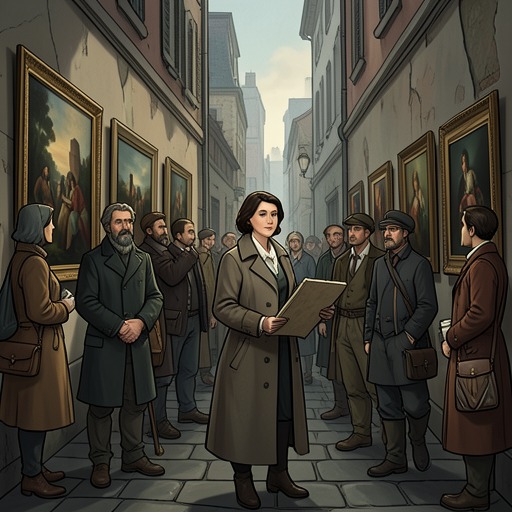
The scale of the opening exceeds Connie’s immediate expectations. Her mother, Ruth Dixon, and her sister, Jean, stay at a local motel because the town’s lodging is completely booked, an unprecedented condition for Hoyt Harbor outside the summer season. Connie expects almost two hundred invited guests. When the doors open, at least a hundred people enter, followed by collectors and investors who spill onto the sidewalk. Visitors have flown in from across the globe, and many recognize Blake’s name from investments made during his earlier career, particularly through the networks of European and Asian art money.
Inside, the gallery becomes a dense public spectacle. Guests move shoulder to shoulder from one image to another, while Blake shakes hands until he is numb and overwhelmed. Connie remains close to him, reporting which works attract attention and fending off purchase offers within the first few minutes. The crowd gathers especially around the portrait of Connie: four people deep, visitors stare at it as though unable to move past. That response gives the portrait a significance beyond its role as a private image. It becomes the visual center of the exhibition and the point at which Connie’s personal transformation is received as art by strangers.
The old seascapes also draw immediate interest, and Connie’s playful question about how many Blake wants to sell reveals her confidence as an agent of the event. She is no longer merely assisting another artist or negotiating from a position of dependence. She is managing the room, interpreting the works, and controlling access to them. Her excitement is the culmination of the gallery dream she had once regarded as a substitute for becoming a famous artist; the opening proves that curatorial and entrepreneurial authority can become her own artistic vocation.
Public Recognition and Reconciliation
Connie’s speech frames the opening as the completion of a dream and presents the gallery as a welcoming place that will bring further exhibitions by important artists to Hoyt Harbor. She thanks Blake for allowing her to show his lost works and his new portrait, explicitly linking the gallery’s success to his generosity. Her public gratitude also makes their relationship part of the institution’s founding story. The gallery is not presented as a neutral commercial venue but as something created through trust, persistence, and shared recovery.
Blake’s response gives the event its deepest emotional reversal. He acknowledges that Connie entered his life during a period of despair and that her love, laughter, passion, and persistence lifted him back toward the joys of living. He had believed that going blind marked the end of his art career, and he painted Connie’s portrait because he wanted redemption. In the crowded gallery, however, he announces that he will begin painting again, not because the market demands it, but because art still contains a part of him that needs to be heard. The announcement surprises both the audience and Connie because he had not previously discussed it with her.
Consequences and Significance
The opening changes the value of the paintings by giving them an audience. Blake recognizes that works without viewers remain dead objects, whereas the collectors’ attention allows the images to live in their minds and imaginations. The approval surrounding him supplies a sense of vindication, but it also stirs regret that he had believed his days of painting were over. Public recognition thus does more than confirm his earlier reputation: it reactivates an artistic hunger that grief and blindness had suppressed.
For Connie, the event completes a movement from exploitation to authorship. Duncan Cartwright had used promises of fame to make her dependent, whereas the Connie Dixon Gallery is founded through her own decision, labor, negotiation, and vision. Her earlier meeting with Warren Ryan, in which she voluntarily adds forty thousand dollars to the three-thousand-dollar payment for two paintings after learning their true value, marks the same ethical and professional shift: she refuses to profit through another person’s vulnerability and begins exercising informed authority within the art market.
The gallery also gives Hoyt Harbor a new public identity. Connie’s return to the town had initially been uncertain, and her new life carried no guarantees beyond the dream of a small gallery. By opening its doors to visitors from Europe, Asia, and elsewhere, the institution connects the coastal town to a global art economy while remaining rooted in the local street, shore, and community. Its success is therefore both intimate and expansive: it establishes Connie’s independence, offers Blake a path back to painting, and turns a place marked by imprisonment and mourning into a setting for work, welcome, and renewed possibility.